
Discovering Destiny (Part 12): It Gets Harder Right Before The Breakthrough

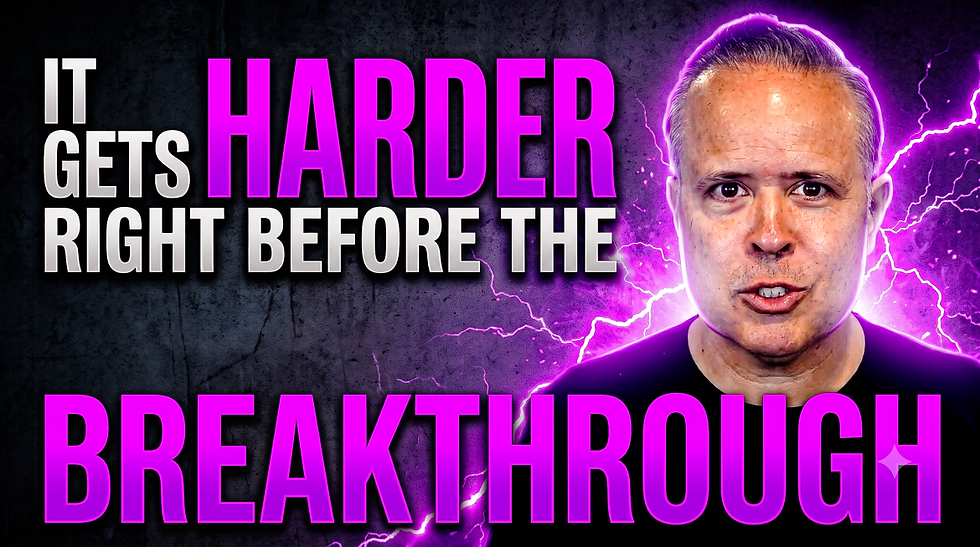
Today, we continue our focus on THE YEAR OF DISCOVERY, as we learn to maintain our posture of faith after God has revealed His plans for our future.
Yesterday, in our “Discovering Destiny” series, we learned the difference between the calling and the preparation. We watched Moses come back at 80, finally processed and in God’s timing, and this time his own people received him, and he got an audience with Pharaoh. He walked into that throne room and delivered God’s demand: let My people go. Today we find out what Pharaoh said back, and what God’s deliverer did when the very first step of obedience seemed to make everything worse. If you have ever obeyed God and watched your situation get harder instead of easier, this message is for you.
Key scriptures for this year:
2 Peter 3:18 GNT“But continue to grow in the grace and in the knowledge of our Savior, Jesus Christ. To Him be glory now and forever.”
Luke 10:20 Mirror“It’s time for you to rediscover who you are from Heaven’s perspective.”
1 John 3:10 Mirror“There is a very visible and vast difference between living one’s life from your God identity or from a fallen man’s mindset.”
Proverbs 25:2 NKJV“It is the glory of God to conceal a matter, but the glory of kings is to search out a matter.”
Jeremiah 29:13 NIV“You will seek me and find me when you seek me with all your heart.”
Scripture we will study today:
Exodus 5:2 ERV“But Pharaoh said, ‘Who is the Lord? Why should I obey him? Why should I let Israel go? I don’t even know who this Lord is, so I refuse to let Israel go.'”
Exodus 5:9 ERV“So make these people work harder. Keep them busy. Then they will not have enough time to listen to the lies of Moses.”
Exodus 6:1 ERV“Then the Lord said to Moses, ‘Now you will see what I will do to Pharaoh. I will use my great power against him, and he will let my people go. He will be so ready for them to leave that he will force them to go.'”
Supporting scriptures:
Exodus 5:7 ERV“You have always given the people straw to use to make bricks. But now, tell them they have to go and find their own straw to make bricks.”
Exodus 5:21 ERV“So they said to Moses and Aaron, ‘May the Lord judge and punish you for what you did! You made Pharaoh and his rulers hate us. You have given them an excuse to kill us.'”
Exodus 5:22-23 ERV“Then Moses prayed to the Lord and said, ‘Lord, why have you done this terrible thing to your people? Why did you send me here? I went to Pharaoh and said what you told me to say. But since that time he has made the people suffer, and you have done nothing to help them!'”
Galatians 6:9 ERV“We must not get tired of doing good. We will receive our harvest of eternal life at the right time. We must not give up.”
Setting the Stage:
The man rejected 40 years earlier had been received by his own people, and he had walked into Pharaoh’s court and said exactly what God told him to say. Everything was finally lining up. The calling and the preparation had met, the timing was right, and Moses obeyed perfectly. So you would expect the next thing to be the breakthrough. It was not.
Pharaoh looked at the demand of God and said, “NO!” I will give you the Rick Piña version. It’s almost like Pharaoh said, “I don’t even know your God, so get out of my face.” Then he made it worse. He cut off the straw, doubled the pressure, and the same people who had just bowed and worshiped now turned on Moses and blamed him for their misery. Moses obeyed God, and his first reward was that everything got harder. Watch what God does with that, because it will change the way you read the hardest stretch of your own obedience.
So, what does this mean for you today? A few things.
1. The First Answer Was No, And No Is Not The Final Answer.
Moses delivered God’s word perfectly. He said exactly what God told him to say, in God’s timing, with God’s backing. And Pharaoh did not even blink. He looked at the command of Almighty God and said: “No, who is the Lord, I will not.” Here is what you have to settle before you take one more step into your assignment. The first NO is not the final answer. A closed door at the start of the journey is not the end of the dream. You should see it as the opening round of the fight.
How this applies to you:
— The Israelites had waited 400 years, and when their deliverer finally came, the first thing they heard was another NO. From inside the brick pits, that NO felt like proof that nothing would ever change. But God had already told Abraham exactly how this would end. Genesis 15:13-14 ERV says God promised their descendants would “leave that land.” The NO you may be facing can never cancel the promise God already spoke.
— A NO at the start of your assignment is not a NO over your assignment.
— Do not measure the correctness of your obedience by the first reaction you get.
— God already knew Pharaoh would refuse. He had told Moses in advance that Pharaoh’s heart would be hard. The NO was never a surprise to God, so it should never be a stop sign to you.
— The first closed door is usually the start of the fight, not the end of the dream.
— Some of you obeyed God, hit a NO, and quit. For whatever reason, you allowed a NO from a man to cancel a YES from God. If you did that, then it is on you, because God will allow whatever you allow. He will permit whatever you permit. Please remember that the next time you’re facing opposition. If you’re not persistent and you don’t remain in faith, you can mess around and put a NO where God put a YES.
2. Sometimes Obedience Makes It Harder Before It Makes It Better.
Here is the part nobody warns you about. After Moses obeyed, things did not get better. They got worse. Pharaoh did not just refuse; he punished the people for even asking. The very first result of Moses doing the right thing at the right time was that life got harder for everybody. If you do not understand this, the difficulty that comes right after your obedience will fool you into thinking you made a mistake.
How this applies to you:
— Exodus 5:9 ERV says Pharaoh ordered, “So make these people work harder. Keep them busy.” The immediate fruit of Moses’ obedience was a heavier burden, not a lighter one.
— Pharaoh even took away the straw and still demanded a full quota of bricks. Exodus 5:7 ERV says he told them to “go and find their own straw.” The pressure went up the moment Moses stepped in.
— Obedience does not always make the road smoother right away. If God tells you to leave your job for another one, start a business, start a nonprofit, or start a ministry, and you know you heard from God clearly, that doesn’t mean that everything on the path is going to be easy. God never promised that it would be easy. He just promised to be with you every step of the way.
— The dip that comes right after you obey is not proof that you missed God. Many times it is proof that you just threatened the thing that was holding you.
— When God starts moving you toward freedom, the enemy tightens his grip right before he loses it.
— Do not read the rise in pressure as a sign you took a wrong turn. The resistance got louder because your deliverance got closer.
— The greater the assignment, the greater the attack. Remember, the attack is against the assignment, and when the enemy sees God’s assignment about to manifest in your life, he will crank up the heat on you, as he did with the Hebrew boys.
— The fight got harder because the breakthrough got closer.
3. The People You Were Sent To Help May Turn On You.
Now it gets personal. The same Israelites who had just bowed and worshiped when Moses showed the signs came looking for him with blame on their lips. When the pressure increased, they did not run to God; they turned on the man God sent. They told Moses he had made everything worse and basically handed Pharaoh a reason to destroy them. The very people Moses was called to help turned on him in a New York minute.
How this applies to you:
— Exodus 5:21 ERV says the people told Moses, “May the Lord judge and punish you for what you did! You made Pharaoh and his rulers hate us.” The people he came to free now blamed him for their pain.
— Yesterday they bowed; today they blame.
— Do not be too hard on the Israelites for turning on Moses. They were not evil; they were desperate and confused. When people cannot see what God is doing, the one carrying the assignment becomes the easiest target for the pain. But this is a good reminder that there’s a high cost for sacrificial leadership.
— Their worship was real, but it was shallow, and the first hardship exposed it. People will celebrate you when it is easy and criticize you when it gets hard.
— The criticism of the people you serve is not permission to abandon the assignment God gave you.
— Moses could have quit right there, offended and discouraged. But the assignment was never about man’s approval. It was about God’s instruction.
— When the very people you are helping turn on you, keep the assignment in God’s hands and not in theirs.
— If you are in ministry or you have been called to serve people, you better remember this one. Ministry is messy, and dealing with people is problematic. The same people you’re trying to help will turn on you in a minute, so you cannot do it for their approval.
4. Discouragement Is Not Disqualification. Take It Back To God.
Watch what Moses did with the weight of it all, because this is the most human moment in the story and one of the most important lessons in it. Moses got discouraged. He went straight back to God and basically said, “Lord, why did You even send me? Things have only gotten worse, and You have done nothing.” That is brutally honest. And here is the beautiful part. God did not rebuke him for the honesty. God answered him with a promise.
How this applies to you:
— Exodus 5:22-23 ERV says Moses prayed, “Lord, why have you done this terrible thing to your people?… you have done nothing to help them!” Even God’s chosen deliverer hit a wall of discouragement.
— Feeling discouraged does not mean you are disqualified.
— Notice Moses did not quit, and he did not just vent to the people. He took his frustration straight to God. That is what you do with discouragement. You carry it to the only One who can actually answer it.
— Then God responded. Exodus 6:1 ERV says, “Now you will see what I will do to Pharaoh.” God reassured Moses that the promise (the breakthrough) was coming. If you’re going to complain, go complain to God because he has a way of reassuring you when you need it.
— Your greatest moments often come right after the moment you feel like nothing is working.
— Galatians 6:9 ERV says, “We must not get tired of doing good. We will receive our harvest… at the right time. We must not give up.” The harvest is real, and it is tied to not quitting in the hard middle.
— The only way you can lose is if you quit, but I declare that there’s no quit in you.
That’s enough for today.
Declaration of Faith:
Father, I thank You that the first no is never Your final answer!
I will not measure my obedience by my first results!
When the pressure rises, I know my breakthrough is getting closer!
The resistance got louder because my deliverance got nearer!
I will not quit in the dip between the promise and the breakthrough!
The applause and the blame of people will not move me off my assignment!
My discouragement is real, but it is not my disqualification!
I take my frustration straight to You, and You answer me with a promise!
I will not grow weary, because my harvest is coming at the right time!
This is THE YEAR OF DISCOVERY, and GREATER IS COMING FOR ME!
I declare this by faith. In Jesus’ name. Amen!
This is Today’s Word. Apply it and prosper!


Comments